Skip to content

Project rescue

The software exists.
It just never made it
across the finish line.

Maybe the original developer left. Maybe priorities changed. Maybe the project technically “works,” but it was never made production-ready.

JeraCode can step into an existing codebase, understand what's there, decide what's worth keeping, and finish the work without starting over unnecessarily.

Tell Us Where It Stalled You don't need a perfect handoff.
We can work from what exists.
Prototype
Core features
Integrations
Testing
Deployment
Production
Let's finish it.

Does this sound familiar?

A stalled project usually doesn't look “stalled.”
It looks almost done.

The developer left.

The person who understood the project is gone, and nobody knows exactly what remains.

It works on someone's laptop.

The application runs, but deployment, hosting, configuration, or production readiness never got finished.

Most of the features are there.

The last 10–20% is integrations, edge cases, testing, security, and all the work nobody wanted to do.

We've been “almost done” for months.

Every week uncovers another blocker, missing dependency, or unfinished decision.

The prototype became the product.

Something intended as a proof of concept is now carrying real business expectations.

Common in 2026

AI got us this far.

AI accelerated the build, but the project now needs architecture, testing, security, deployment, or experienced engineering to actually ship.

Finished means more than “it runs”

Shipping software means closing the gaps nobody sees in the demo.

A project isn't done because the happy path works. It's done when the business can safely depend on it.

Core functionality

  • Critical workflows completed
  • Missing features finished
  • Broken edge cases addressed
  • Business rules validated

Integrations

  • External systems connected
  • API failures handled
  • Authentication working
  • Data synchronization completed

Production readiness

  • Configuration cleaned up
  • Deployment process established
  • Logging and monitoring added
  • Environment differences resolved

Security

  • Authentication reviewed
  • Authorization / RBAC verified
  • Secrets removed from code
  • Common vulnerabilities addressed

Data

  • Database migrations completed
  • Queries reviewed
  • Data cleanup handled
  • Failure/retry paths considered

Quality

  • Critical paths tested
  • Error handling improved
  • Known blockers resolved
  • Documentation added where useful

No perfect handoff required

We don't need the original developer to explain everything.

Sometimes there's documentation. Sometimes there's a backlog. Sometimes there's a half-working repository, an old deployment, and a folder full of notes.

We can start by understanding what actually exists.
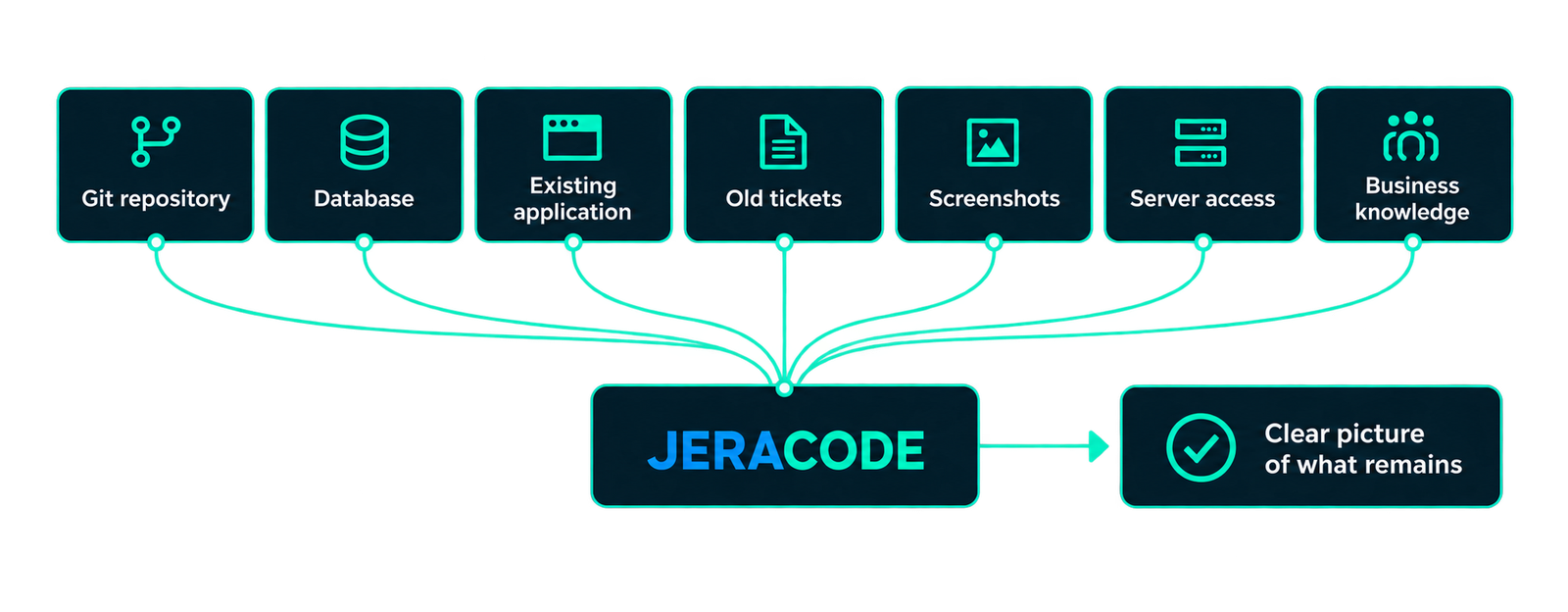
Git repository, database, application, tickets, screenshots, server access, and business knowledge flow into JeraCode to create a clear picture of what remains.
Git repositoryDatabaseExisting applicationOld ticketsScreenshotsServer accessBusiness knowledge
JERACODEClear picture
of what remains

We don't assume everything should stay

First, we figure out what's worth finishing.

Taking over a project doesn't mean blindly completing every decision that came before us. We evaluate what exists and make practical calls based on business value, risk, and effort.

Keep

Working code that already does its job.

Fix

Useful pieces that need stabilization or cleanup.

Finish

Incomplete features and integrations worth completing.

Replace

Parts that would cost more to rescue than rebuild.

AI-built projects

AI got you surprisingly far.
We can help get it shipped.

AI is excellent at rapidly turning an idea into working software.

But projects often hit a point where prompting harder stops solving the real problem. Architecture, security, deployment, data integrity, integrations, testing, and production behavior still need deliberate engineering.

Keep the momentum. Add the engineering needed to finish.

Common signs you've reached that point:

  • Every new prompt breaks something else
  • Multiple implementations of the same feature exist
  • Nobody is sure which code is actually used
  • Authentication feels fragile
  • Deployment is manual or unreliable
  • The database evolved without a plan
  • The app works in development but not consistently in production
  • AI keeps “fixing” symptoms instead of the underlying issue
// From prototype
// to production.
  • Idea
  • Prototype
  • Cleanup
  • Testing
  • Deployment
  • Production

How we finish a stalled project

We follow a proven, practical process.

  1. 1

    Assess

    Understand the codebase, architecture, environments, data, integrations, backlog, and actual business goal.

  2. 2

    Define “done”

    Separate must-have launch requirements from nice-to-have work and leftover ideas.

  3. 3

    Prioritize

    Identify blockers, dependencies, high-risk areas, and the shortest practical path to usable software.

  4. 4

    Unblock

    Resolve the technical problems preventing the team or application from moving forward.

  5. 5

    Complete

    Finish critical functionality, integrations, testing, deployment, and production-readiness work.

  6. 6

    Release

    Get the application into real use with enough monitoring, documentation, and support to make the transition manageable.

The goal isn't to finish every ticket. It's to finish the software the business actually needs.

Scope creep vs. finish line

Ship the important version first.

Not every idea has to make it into the first production release. We help separate what the business actually needs now from what can safely come next.

What happens

  • New idea
  • Another feature
  • Another integration
  • Another redesign
  • Still not launched

What we do

  • Define launch
  • Protect critical scope
  • Resolve blockers
  • Finish essentials
  • Release
  • Improve afterward

What a successful Finish It engagement looks like

Before

  • Nobody knows exactly what remains
  • The backlog keeps growing
  • Critical integrations are incomplete
  • Deployment is unreliable
  • The team has lost momentum
  • “Almost done” has lasted months

After

  • Clear definition of done
  • Known blockers resolved
  • Critical work completed
  • Production path established
  • Software released
  • Team knows what comes next

Not every idea completed. The right product shipped.

Finish It works especially well when...

  • You already have meaningful software worth preserving
  • The project has stalled rather than failed completely
  • The original developer or vendor is gone
  • Your team needs experienced technical direction
  • The last 20% is proving harder than the first 80%
  • A prototype needs to become a real application
  • AI helped build the product but can't reliably get it over the line
  • You need somebody to make practical decisions instead of just writing more code

Let's get it shipped

Tell us where the project got stuck.

You don't need a perfect backlog, technical specification, or handoff document.

Show us what exists, what the business expected, and what's preventing it from getting into real use.

Tell Us Where It Stalled No pitch deck required. Start with what you have.